| Played: | 7 times |
| Classification: | Dle Games |
Doctordle takes the familiar Wordle formula and gives it a medical degree. Instead of guessing everyday five-letter words, you work through clinical cases, reading patient symptoms and medical clues to identify the correct diagnosis. Each round starts with a short patient presentation, then gradually reveals more information as you make guesses. You can jump straight into Doctordle and see where your medical knowledge takes you. Just be prepared for a few diagnoses you have not thought about since medical school.
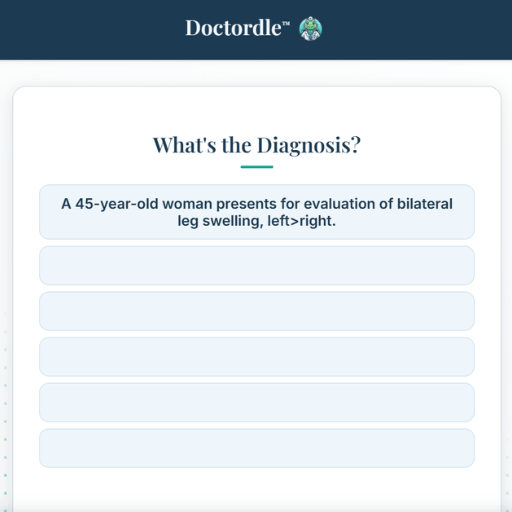
Every case begins with a patient and a problem. A 12-year-old boy has rough, raised skin lesions. A newborn arrives with cyanosis and rapid breathing. A woman struggles with poor sleep, nightmares and difficulty concentrating at work. Your job is to connect those details to the most likely condition.
The opening description rarely tells the whole story. Additional details appear as you work through the case, including medical history, physical examination findings, travel history and test results. Fever and muscle pain may send the patient down the road of influenza, but if the patient has been recently out of the country, malaria or another infectious disease is a differential. Similarly, chest pain can be a heart attack until an ECG and negative troponins say otherwise.
Making Doctordle more than some flash-memory, medical terms game. You need to recognize patterns, reconsider early assumptions and know which clues actually matter.
Some rounds cover familiar diagnoses such as common warts, influenza, boxer's fractures and ulcerative colitis. Others venture into less everyday territory, with conditions like hairy leukoplakia, eosinophilic granulomatosis with polyangiitis, amebic liver abscess and even bubonic plague.
The difficulty comes from how similar several conditions can look at first. Fever, abdominal pain or breathing problems can lead in multiple directions, so jumping at the first familiar diagnosis is not always the smartest move. Sometimes you need to skip, gather another clue and come back with a better idea.
Doctordle works particularly well for medical students, healthcare professionals and anyone who enjoys clinical reasoning. You do not need to know every rare disease to have a good time, but a solid understanding of symptoms, anatomy and common conditions certainly helps. Even wrong guesses can expose gaps in your knowledge and introduce diagnoses worth looking up afterward.
If you enjoy testing your knowledge beyond the hospital, head over to Sports Krillion for another round of challenges and competitive fun.